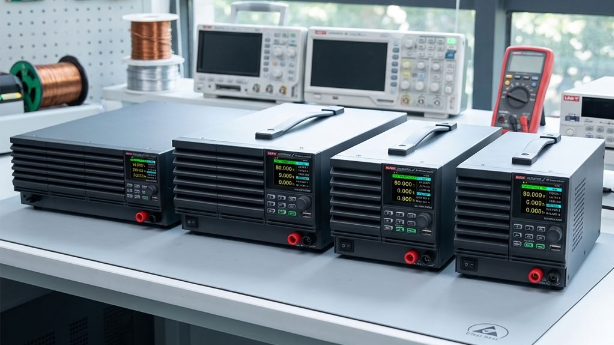
When a test outgrows one supply, the choice is a bigger supply or a second identical one. Linked UDP5000 units act as one: you set the master, the others follow, and the output adds up in current (parallel) or in voltage (series).
Red is positive, grey is negative. The grey ribbon is the link cable between the units’ rear interface ports. Numbers show what each unit carries at the load you set.
Parallel adds current
In parallel, the positive terminals join and the negative terminals join, and the load sits across them. Each unit holds the same voltage and the currents add. Four UDP5080-20 units give 80 V at up to 80 A and 1,600 W.
Up to four units link on the 400 W, 800 W and 1,200 W models, and two on the 2,000 W models. Combined output is capped at 5,000 W, so the largest group is four 1,200 W units at 4,800 W.
Series adds voltage
In series, the positive terminal of the first unit connects to the negative terminal of the second, and the load sits across the outer two. The voltages add and the current is the rating of one unit. Two UDP5250-6 units reach 500 V at 6 A. Series operation is limited to two units, and the 800 V models run in parallel only.
How the units share the work
The units are linked by a ribbon cable on the rear interface port. On each unit you choose its role in the menu: master, or slave with an ID. After that you set voltage and current on the master only, and the slaves follow it. The data sheet allows up to about 5 % of the rated value of difference between master and slave, so in a four-unit UDP5080-20 group each unit carries 20 A ± 1 A at full load.
Wire the load to the rear output terminals. The front binding posts are limited to 10 A per unit.
Check the outlets before you build the rack
Each unit draws its own AC input. The data sheet gives full-load input current at 100 V and at 200 V. A 2,000 W model draws 28 A at 100 V, more than a 120 V branch circuit is built for, so plan 208 V or 240 V circuits for those models. At 1,200 W the figure is 16.8 A at 100 V, which needs a dedicated 20 A circuit per unit on 120 V.
Try this
- Pick the UDP5080-20, Parallel, 4 units. The group reaches 80 A. Set a 50 A load and each unit carries 12.5 A.
- Switch to Series. The button for 3 and 4 units turns off, and the group reaches 160 V at 20 A.
- Pick a 2,000 W model. Parallel stops at 2 units, and the AC input line shows why the outlet matters.
Linked operation needs identical models. Ratings and limits are from the UDP5000 data sheet and UNI-T’s confirmation of the parallel limits.
Up to four units in parallel, two in series. 20 models, one link cable.
See the UDP5000 seriesRelated: Series vs. parallel circuits. UNI-T. Design. Debug. Deploy.™