A motor drive, an inverter or a DC-DC module often has thousands of microfarads across its input. Charging that capacitance takes current in proportion to how fast the voltage rises. Switch the supply on at full speed and the board sees a current spike. Ramp it at a rate you choose and the current is a number you set in advance.
Yellow: output voltage. Blue: current into the load. Red dashes: the supply’s current setting. Purple dashes: the rating you enter for the board’s input fuse or connector.
The current a capacitor asks for
A capacitor draws current only while its voltage is changing. The current is the capacitance times the rate of rise:
Take 4,700 µF and bring it to 24 V in 5 ms. The rate is 4,800 V/s and the current is 22.6 A, for a board that runs on 2 A. The same capacitor ramped over half a second needs 0.23 A.
What a fast start does
On a fast start, the supply’s own speed sets the rate of rise. Either the current goes to the setting and the supply drops into constant current until the capacitor has charged, or, with a generous current setting, the board’s input fuse, connector and precharge parts take the full spike. Neither tells you how the board behaves when it is powered the way the product will be.
Setting the ramp
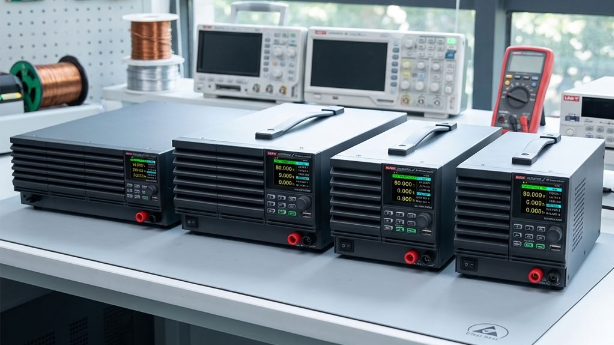
The UDP5000’s slope modes let you set how fast the output voltage rises and falls, in volts per second. UNI-T gives the range as 0.01 V/s to 500 V/s. With the rate fixed, the charging current is fixed too, and you can choose it: well under the fuse rating to bring a board up gently, or at a known value to check that a soft-start or precharge circuit works.
The supply’s protection has its own delay. Over-voltage and over-current protection can wait from 10 ms to 10,000 ms before acting, so a short, expected peak does not shut the output down while a sustained fault still does.
Try this
- On the UDP5040-40 at 24 V with 4,700 µF, compare High speed with Set slope at 100 V/s. The charging current drops from at least 2.26 A to 0.47 A.
- On High speed, lower the current setting. The supply goes into current limit, and the ramp time grows to whatever that current allows.
- Raise the capacitance to 47,000 µF at 100 V/s. The charging current reaches 4.7 A, still a value you chose.
The High speed estimate uses the data sheet rise time at rated load (below 50 ms for the 40 V and 80 V models, 100 ms for 160 V and 250 V, 250 ms for 800 V) as the ramp. A real fast start can be quicker, so treat that figure as a lower bound on the spike. Board current after the capacitor has charged is not included.
Adjustable voltage and current slope on all 20 models.
See the UDP5000 seriesRelated: Constant voltage vs. constant current. UNI-T. Design. Debug. Deploy.™