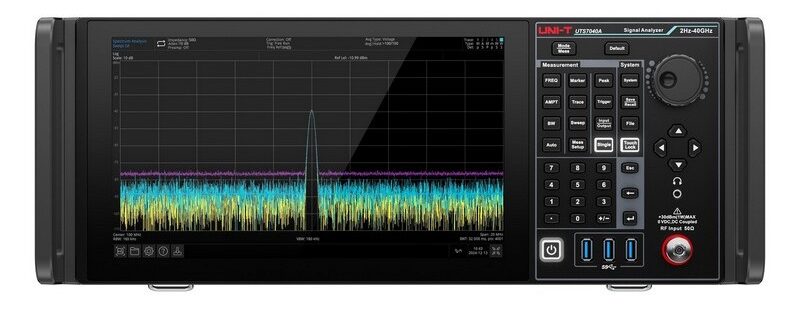
August 29, 2026 – The UNI-T UTS7000A series delivers professional-grade signal analysis across a broad frequency range from 2 Hz to 40 GHz, making it a powerful platform for RF, microwave, wireless, EMC, radar, satellite, and power-electronics applications. Built as an Interceptor-Series signal analyzer family, the UTS7000A combines high sensitivity, real-time spectrum analysis, 100% Probability of Intercept (POI), low phase noise, and extensive measurement options in a modern touchscreen instrument. With four frequency tiers—13.6 GHz, 26.5 GHz, 32 GHz, and 40 GHz—and standard and narrowband configurations, the series allows engineers to select the performance level that best matches their application.
Visit the UTS7000A Series webpage here .
Professional Signal Analysis from 2 Hz to 40 GHz
The UTS7000A series is designed to cover applications ranging from low-frequency power-electronics analysis to advanced microwave and millimeter-wave development. Unlike conventional spectrum analyzers that often begin at 9 kHz, the UTS7000A starts at just 2 Hz, allowing engineers to analyze low-frequency switching components, motor-drive harmonics, conducted emissions, and RF signals using a single instrument.
The series includes four primary frequency configurations:
- UTS7013A — 2 Hz to 13.6 GHz
- UTS7026A — 2 Hz to 26.5 GHz
- UTS7032A — 2 Hz to 32 GHz
- UTS7040A — 2 Hz to 40 GHz
Each frequency tier is also available in an -NB narrowband configuration with fixed 20 MHz real-time analysis bandwidth. Standard models begin with 40 MHz real-time bandwidth and can be expanded through software options to 85 MHz, 160 MHz, or 255 MHz.
Key Features of the UTS7000A Series:
✅ 2 Hz to 40 GHz Frequency Coverage
Analyze signals from low-frequency power electronics through RF, microwave, and millimeter-wave applications.
✅ -167 dBm/Hz DANL
High sensitivity enables detection and characterization of weak signals, spurious emissions, and low-level interference.
✅ 100% Probability of Intercept
Capture transient, intermittent, and frequency-hopping signals without missing events during real-time analysis.
✅ Up to 255 MHz Real-Time Analysis Bandwidth
Standard models can be expanded from 40 MHz to 85 MHz, 160 MHz, or 255 MHz for wideband signal capture.
✅ < -110 dBc/Hz Phase Noise
Low phase noise supports demanding RF measurements and signal characterization.
✅ Up to 100,001 Sweep Points
Perform detailed swept-spectrum measurements across wide frequency ranges.
✅ 11.6-Inch HD Multi-Touch Display
The 1920 × 1080 touchscreen provides a clear interface for spectrum visualization and measurement control.
✅ Extensive Software Options
Add 5G NR, LTE, vector signal, I/Q, phase-noise, analog demodulation, EMI, and advanced RF measurement capabilities as needed.
Real-Time Spectrum Analysis for Transient Signals
One of the defining capabilities of the UTS7000A is its real-time spectrum analysis architecture. With 100% Probability of Intercept, the analyzer is designed to capture transient events that may be difficult to observe with traditional swept-spectrum measurements.
This capability is particularly valuable when investigating frequency-hopping signals, intermittent interference, burst transmissions, transient emissions, and other short-duration RF events. Engineers can observe signal behavior in real time rather than relying solely on repeated sweeps that may miss an event between acquisitions.
Standard UTS7000A models provide 40 MHz of real-time analysis bandwidth and can be upgraded to 85 MHz, 160 MHz, or 255 MHz. This makes the platform suitable for applications ranging from conventional narrowband RF measurements to wideband Wi-Fi, 5G, radar, and multi-carrier signal analysis.
Flexible Bandwidth Configurations
The UTS7000A family gives engineers a choice between standard upgradeable models and fixed-bandwidth -NB models.
Standard models include 40 MHz of real-time analysis bandwidth and support optional B85, B160, and B255 upgrades. The 85 MHz option is suitable for applications such as 80 MHz Wi-Fi channels and wideband radar. The 160 MHz option is designed for Wi-Fi 6E 160 MHz channels and wider 5G NR applications, while the 255 MHz option provides the maximum real-time bandwidth available on the platform.
The -NB models provide 20 MHz of fixed real-time bandwidth and are intended for applications where wider capture bandwidth is not required. These configurations can be attractive for narrowband wireless testing, component characterization, CW measurements, and EMC pre-compliance work. Because the -NB architecture cannot be upgraded, engineers who anticipate future wideband requirements should select a standard model.
High Sensitivity for Weak-Signal Detection
With a displayed average noise level of up to -167 dBm/Hz, the UTS7000A provides the sensitivity needed to investigate low-level signals and unwanted emissions. This is particularly useful for spurious-response measurements, interference hunting, receiver characterization, and EMC work.
The analyzer also provides phase-noise performance below -110 dBc/Hz at 1 GHz with a 10 kHz offset. Together, low noise and strong sensitivity provide a foundation for accurate RF measurements across the instrument’s frequency range.
For applications requiring additional sensitivity, frequency-specific internal preamplifier options are available for the 13.6 GHz, 26.5 GHz, 32 GHz, and 40 GHz configurations.
Advanced RF and Vector Signal Analysis
The UTS7000A can be expanded beyond conventional spectrum analysis through a range of software licenses. The VSA option adds vector signal analysis and supports modulation formats including ASK, FSK, PSK, QAM, MSK, and DPSK. The I/Q option enables raw I/Q capture and export for further analysis in external tools.
For engineers working with cellular technologies, dedicated demodulation options are available for 5G NR, FDD-LTE, and TDD-LTE. The 5G NR option provides measurements such as EVM and constellation analysis, while the LTE options provide dedicated measurements for their respective air interfaces.
These capabilities make the UTS7000A suitable for wireless-device development, base-station testing, communications research, and advanced RF troubleshooting.
Comprehensive RF Measurement Tools
The optional Advanced Measurement Kit expands the analyzer with dedicated measurement functions for common RF characterization tasks. These include third-order intercept measurements, occupied bandwidth, channel power, adjacent-channel power ratio, carrier-to-noise ratio, harmonic analysis, time-domain power, and spectrum monitoring with waterfall visualization.
The analog demodulation option adds AM, FM, and PM analysis, including modulation depth, frequency deviation, phase deviation, carrier power, SINAD, modulation distortion, and total harmonic distortion measurements.
A dedicated phase-noise measurement option is also available for applications requiring specialized phase-noise characterization.
EMI and Pre-Compliance Testing
The UTS7000A can also be configured for electromagnetic-interference pre-compliance testing through its EMI measurement option. The option adds quasi-peak, average, and RMS detectors, along with more than 100 limit lines covering standards such as CISPR, FCC, EN, and MIL-STD. Automatic scanning functions further simplify emissions testing.
The 2 Hz starting frequency is particularly useful for applications where engineers need to evaluate conducted emissions and low-frequency components before moving into higher-frequency radiated-emission testing.
For an EMC laboratory, the UTS7013A combined with the EMI option provides a practical configuration covering applications through 13.6 GHz, while the internal preamplifier option can further improve sensitivity for low-level signals.
Designed for 5G, Radar, and Satellite Applications
The higher-frequency UTS7000A models provide the frequency coverage required for modern microwave and millimeter-wave applications.
The UTS7026A extends to 26.5 GHz and is suited to 24 GHz automotive radar, K-band satellite applications, and microwave backhaul. The UTS7032A reaches 32 GHz for applications such as 5G NR n257/n258 and Ka-band satellite uplinks. The UTS7040A extends to 40 GHz for applications including 5G NR n260, Q-band communications, and sub-harmonic analysis of 77–81 GHz radar systems.
When combined with the B255 real-time bandwidth option and 5G NR or vector-signal analysis capabilities, the higher-frequency models provide a flexible platform for wideband wireless and microwave research.
Large HD Touchscreen and Intuitive Operation
Every UTS7000A model features an 11.6-inch, 1920 × 1080 HD multi-touch display. The large screen provides ample space for viewing spectrum traces, real-time analysis results, measurement parameters, and waterfall displays.
The touchscreen interface makes it easier to configure measurements, navigate frequency ranges, and interact with spectrum displays during troubleshooting and characterization. The consistent interface across the UTS7000A family also simplifies operation when laboratories use multiple frequency configurations.
Remote Control and Automated Test Integration
The UTS7000A is designed for integration into automated measurement environments. LAN Gigabit Ethernet and USB 3.0 interfaces are provided as standard, while GPIB is available as an option. SCPI remote programming allows engineers to control measurements and integrate the analyzer into automated test systems.
The platform supports Ubuntu Linux as standard, with Windows 10 available as an option. Both operating environments support SCPI remote control through LAN and USB, making the analyzer suitable for laboratory automation, production testing, and remotely managed measurement systems.
Lifetime-Unlock Software Architecture
The UTS7000A uses a lifetime-unlock licensing approach for its software options. This allows engineers to purchase additional capabilities as their measurement requirements evolve without replacing the instrument.
Options can be added to the analyzer through licensing and include real-time bandwidth expansions, 5G NR and LTE demodulation, vector signal analysis, I/Q analysis, phase-noise measurement, analog demodulation, EMI testing, and advanced RF measurements.
This modular approach allows organizations to configure an analyzer for current requirements while maintaining a path for future measurement needs.
Choosing the Right UTS7000A Model
Selecting a UTS7000A configuration comes down primarily to two factors: maximum frequency and real-time bandwidth.
The UTS7013A is suited to Wi-Fi, Bluetooth, IoT, sub-6 GHz 5G, EMC, and general RF laboratory work. The UTS7026A adds coverage for 24 GHz automotive radar and K-band applications. The UTS7032A extends into 5G mmWave and Ka-band satellite applications, while the UTS7040A provides the series’ maximum 40 GHz frequency coverage for advanced mmWave, Q-band, and radar-related work.
For bandwidth, standard models are the better choice when future expansion may be required, since their 40 MHz real-time bandwidth can be upgraded to 85 MHz, 160 MHz, or 255 MHz. The -NB versions are fixed at 20 MHz and are intended for applications that do not require wider real-time capture.
Ideal Applications
The UTS7000A series is designed for a wide range of professional environments. In wireless R&D, the real-time analysis capabilities, vector signal analysis, and optional 5G/LTE demodulation provide tools for characterizing modern communication systems.
For EMC and EMI testing, the low starting frequency, high sensitivity, real-time capture, and optional EMI measurement functions provide a flexible platform for pre-compliance work. In automotive radar development, the 26.5 GHz and 40 GHz models provide the frequency coverage required for 24 GHz and higher-frequency radar-related applications.
For satellite and microwave communications, the 26.5 GHz, 32 GHz, and 40 GHz models cover K-, Ka-, and Q-band applications, while vector and I/Q analysis options support advanced modulation and signal characterization.
The UTS7000A is also suitable for power-electronics analysis, where its 2 Hz starting frequency enables engineers to examine switching harmonics, motor-drive emissions, inverter behavior, and other low-frequency phenomena that may fall below the starting frequency of conventional RF spectrum analyzers.
Availability and Support
The UTS7000A Series Interceptor-Series Signal Analyzers is available through authorized UNI-T distributors. The family includes standard and -NB configurations covering 13.6 GHz, 26.5 GHz, 32 GHz, and 40 GHz, with standard models offering upgradeable real-time analysis bandwidth and -NB models providing fixed 20 MHz real-time bandwidth. The current UNI-T US product collection lists several configurations as backordered and recommends contacting UNI-T for lead-time information.
All UTS7000A models include a five-year parts-and-labor warranty. For detailed specifications, pricing information, configuration recommendations, or lead-time information, visit the UTS7000A product collection or contact your local UNI-T representative.
About UNI-T
UNI-T is a leading manufacturer of precision test and measurement equipment, providing innovative solutions for electronic design, manufacturing, service, and educational applications. With over 20 years of experience in the test and measurement industry, UNI-T continues to develop instruments that help engineers and technicians work more efficiently and effectively. The company maintains research and development centers in Asia, Europe, and North America, ensuring cutting-edge technology and responsive customer support worldwide.
Media Contact:
UNI-T Marketing Department
Email: marketing@uni-trendus.com
Tel: +1-888-668-8648 (North America)
www.uni-trendus.com