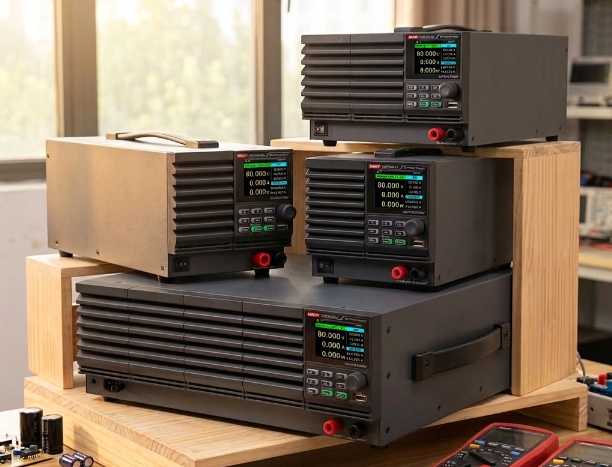
Explore UNI-T UDP5000 Programmable DC Switching Power Supplies: https://uni-trendus.com/collections/udp5000-power-supplies
Traditional programmable DC power supplies are designed to mimic ideal voltage sources with zero internal resistance, delivering stable output voltage regardless of load current changes. However, real-world energy sources, including lithium-ion batteries, lead-acid batteries, photovoltaic panels, and fuel cells, all have non-negligible inherent internal resistance, which causes inevitable voltage sag, dynamic response delay, and load-dependent output characteristics under operating conditions. The adjustable internal resistance (AIR) function, a core advanced feature of modern high-performance DC power supplies, enables power sources to simulate the non-ideal output characteristics of physical energy sources accurately. This paper systematically elaborates on the working principle of the adjustable internal resistance function, analyzes the limitations of traditional ideal power supply testing, and discusses the indispensable application value of AIR function in consumer electronics, automotive electronics, new energy equipment, and industrial reliability testing. The research proves that AIR is not an optional auxiliary function but a core configuration that determines the authenticity and effectiveness of power-dependent device testing.
In electronic research and industrial production testing, programmable DC power supplies serve as the core power simulation equipment for powering Device Under Test (DUT) and verifying electrical performance. For a long time, the mainstream evaluation standard for power supplies focused on output accuracy, ripple noise, stability, and power range. Most conventional switching DC power supplies adopt an ideal source design, maintaining constant output voltage in constant-voltage (CV) mode even with sharp changes in load current.
Nevertheless, almost all natural DC energy sources in practical engineering scenarios are non-ideal. Their terminal voltage decreases linearly with the increase of load current due to internal resistance, and they present unique dynamic response characteristics during transient load switching. The gap between ideal power supply output and real energy source characteristics leads to inaccurate test data, insufficient verification of DUT adaptability, and potential hidden dangers of product field failure.
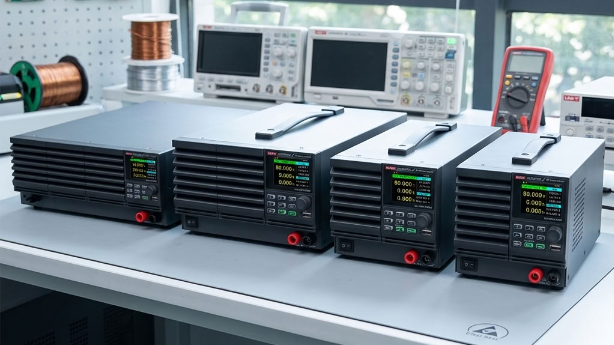
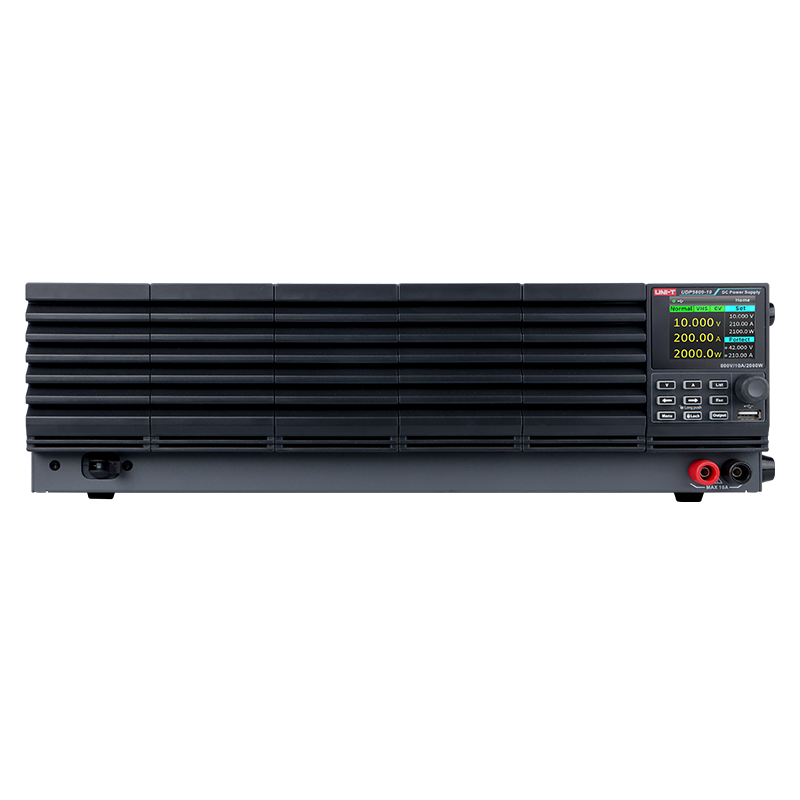
High-end programmable power supplies represented by UNI-T UDP5080-40 and UDP5080-60 integrate built-in adjustable internal resistance simulation technology. This function breaks through the limitations of ideal power output, realizes real-time and precise simulation of non-ideal source characteristics, and has become a key indicator to distinguish high-precision test power supplies from ordinary industrial power supplies.
2. Working Principle of Adjustable Internal Resistance (AIR) Function
The adjustable internal resistance function is a software and hardware collaborative control technology based on real-time current sampling and dynamic voltage compensation. Different from external series fixed resistors, the digital AIR function realizes high-precision, real-time adjustable virtual resistance without additional power loss and circuit volume.
The core logic of AIR simulation follows the terminal voltage calculation formula of physical energy sources:

Where is the preset output voltage of the power supply,
is the real-time load current, and
is the user-programmable virtual internal resistance. When the load current changes, the power supply dynamically adjusts the actual output voltage in real time according to the set internal resistance value, realizing the linear voltage drop characteristic consistent with real batteries and new energy power sources.
2.2 Technical Advantages of Built-In Digital AIR
Traditional resistance simulation relies on external series power resistors, which has obvious defects: fixed resistance value, large heat generation, power loss, low adjustment accuracy, and inability to realize dynamic programming. In contrast, the built-in adjustable internal resistance of high-performance power supplies has significant advantages: continuous adjustable resistance value, zero additional power consumption, fast transient response, support of SCPI remote programming, and synchronous coordination with output slope and sequence testing functions. It can accurately simulate the internal resistance characteristics of various energy sources from new batteries to aged and degraded batteries.
3. Limitations of Traditional Ideal Power Supply Testing
Ordinary zero-internal-resistance power supplies maintain a fixed terminal voltage under any load current, which is completely different from the operating state of real equipment powered by batteries or new energy sources. This test deviation will lead to three core testing failures.
3.1 Inaccurate Verification of Dynamic Load Adaptability
Most electronic devices have pulsed current and sudden load change working conditions. For example, automotive ECUs, drone power management systems, and portable communication devices will generate instantaneous large current during startup, acceleration, and high-load operation. Real batteries will produce obvious voltage drop under instantaneous heavy load, which may trigger under-voltage protection, power reset, or performance attenuation of DUT. However, ideal power supplies maintain stable voltage, which cannot trigger the above failure scenarios, resulting in manufacturers failing to detect dynamic load defects in advance.
3.2 Inability to Simulate Battery Aging and Degradation Characteristics
The internal resistance of lithium batteries and lead-acid batteries will increase significantly after aging, cycling, and low-temperature operation, which aggravates voltage drop under load and reduces equipment endurance and stability. Traditional power supplies cannot simulate the resistance change of battery aging, so the reliability test of products in full life cycle and extreme environments is incomplete, and the test results cannot cover actual working conditions.
3.3 Increased Test Cost and System Complexity
To make up for the lack of internal resistance simulation, traditional test schemes need to connect external programmable resistance boxes, power resistors, and signal conditioning circuits in series. This not only increases test bench volume and wiring complexity but also introduces additional line resistance and signal interference, reducing test repeatability and consistency, and greatly improving the threshold of automated test system integration.
4. Core Application Value of Adjustable Internal Resistance Function
The adjustable internal resistance function solves the core pain point of inconsistent test conditions and actual working conditions, and its application value covers multiple key industrial testing scenarios, becoming an indispensable function for high-reliability product verification.
4.1 Battery and Battery-Powered Product Testing
Battery simulation is the most typical application of AIR function. Engineers can set different internal resistance values to simulate new batteries, aged batteries, low-temperature batteries, and faulty batteries, and verify the power management algorithm, under-voltage protection logic, and load capacity of DUT. For wearable devices, mobile terminals, and industrial handheld equipment, AIR testing can effectively verify product stability during battery power drop and aging, avoiding mass failures in actual use caused by insufficient algorithm adaptability.
4.2 Automotive Electronic Control Unit (ECU) Testing
Automobile 12V/24V power batteries have obvious internal resistance characteristics. When the vehicle starts or the electrical system works at full load, the battery voltage drops sharply, which puts forward strict requirements for the anti-interference and voltage adaptation range of automotive ECUs. The AIR function can accurately simulate the voltage sag characteristics of automotive batteries under dynamic loads, verify the startup stability, communication reliability, and fault tolerance of ECUs under weak power supply conditions, and meet the strict automotive-grade reliability test standards.
4.3 New Energy Power Source Simulation Test
Photovoltaic panels and fuel cells have inherent output impedance characteristics, and their terminal voltage changes significantly with light intensity and load fluctuation. The adjustable internal resistance function can cooperate with the power supply sequence output and slope adjustment functions to simulate the dynamic output characteristics of new energy power sources, providing accurate test conditions for the research and development of photovoltaic inverters, fuel cell controllers, and energy storage equipment, and improving the accuracy of power conversion efficiency and stability test data.
4.4 Automated Test System (ATE) Integration
High-performance power supplies with AIR function support SCPI remote programming and synchronous linkage with test systems. It can realize one-click switching of multiple internal resistance parameters in automated tests, complete full-condition traversal tests of DUT at one time, eliminate manual replacement of external resistance equipment, improve test efficiency, and ensure the consistency and traceability of test data, which is very suitable for batch production testing and laboratory standardized testing.
5. Differentiation Advantage of AIR-Equipped Power Supplies in Market Selection
At present, most ordinary programmable power supplies in the U.S. and global markets (including mainstream models of partial Siglent, BK Precision, and Chroma) only provide ideal constant voltage and constant current output, without built-in adjustable virtual internal resistance function. Although these products have high power and wide voltage range, they cannot complete battery simulation and non-ideal power source test scenarios, and are only suitable for simple power supply and aging tests.
Models such as UNI-T UDP5080-40 and UDP5080-60 integrate native adjustable internal resistance, output slope adjustment, CC/CV priority mode, and intelligent discharge load functions, which perfectly match the full-scenario test requirements of new energy and electronic products. Compared with high-end European and American brands such as EA Elektro-Automatik, they have the advantages of compact desktop design, high cost performance, and convenient deployment, filling the gap between high-precision industrial power supplies and ordinary commercial power supplies.
The adjustable internal resistance function is a core technological breakthrough that enables programmable DC power supplies to move from “ideal power supply simulation” to “real physical energy source simulation”. It effectively makes up for the test deviation caused by the zero-resistance output of traditional power supplies, realizes accurate simulation of batteries, photovoltaic, fuel cells and other non-ideal power sources, and improves the comprehensiveness, authenticity and reliability of electronic product performance and reliability tests.
In the fields of consumer electronics R&D, automotive electronics verification, new energy equipment testing and automated industrial testing, adjustable internal resistance is no longer an optional auxiliary function but a necessary core configuration for high-quality test power supplies. For engineering users and test institutions pursuing high-precision and high-reliability test results, selecting power supplies with native adjustable internal resistance function is the key to ensuring test validity and avoiding product field failure risks.
[1] Tektronix. DC Power Supply Technical Information: Dynamic Load and Battery Simulation Testing
[2] Kikusui America. Bipolar Power Supply Complete Guide: Variable Internal Resistance Application in Automotive ECU Testing
[3] Matsusada Precision. Variable Internal Resistance Function Principle and Application Specification
[4] EA Elektro-Automatik. Virtual Internal Resistance Technology for New Energy Power Simulation