Explore the UDP4303S Programmable Linear DC Power here: https://uni-trendus.com/products/udp4303s
Abstract
Modern electronic development, including semiconductor validation, Internet-of-Things device testing, and multi-channel circuit characterization, demands high-performance programmable DC power supplies that deliver precise adjustable output while safeguarding devices-under-test (DUT), test hardware, and the power instrument itself. Over-Voltage Protection (OVP) and Over-Current Protection (OCP) are core safety subsystems of high-end power supplies. This paper analyzes the value of OVP and OCP by referencing the UNI-T UDP4303S, a four-channel isolated programmable linear DC power supply. It explains the risks from voltage and current excursions, the implementation of configurable OVP/OCP on UDP4303S, and how these protections improve testing reliability, prevent hardware damage, and support repeatable laboratory validation.
Keywords: OVP; OCP; programmable DC power supply; device-under-test protection; multi-channel power supply; UNI-T UDP4303S
1. Introduction
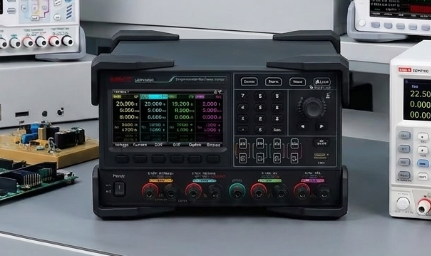
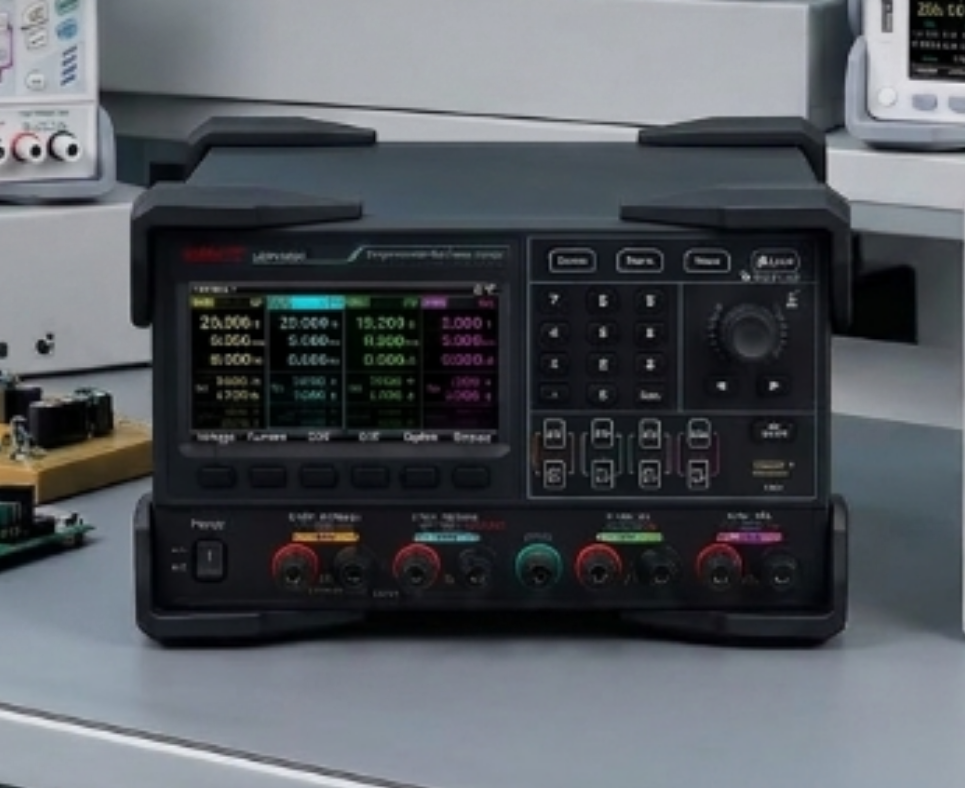
Bench-top programmable DC power supplies serve as controlled energy sources for research, product validation, and failure analysis. As test targets grow more complex, multi-channel isolated outputs are widely adopted; the UNI-T UDP4303S offers four electrically isolated channels: two channels of 0–32 V/3 A, one channel of 0–15 V/3 A, and one high-current channel of 0–6 V/10 A, with total maximum output power reaching 297 W. This instrument supports internal series-parallel operation of CH1 and CH2, remote 4-wire sensing, arbitrary list waveform generation, data recording, and SCPI-based remote control for automated test systems.
High-precision settings, fast transient response (< 50 μs), high-speed sampling up to 8 kSa/s, and multi-group programmable outputs bring powerful test capability, yet also introduce risk factors. Human operational error, programming mistakes, DUT short-circuit failure, unexpected load transients, or communication faults can produce over-voltage or over-current conditions. Without dedicated protection mechanisms, these abnormal conditions may permanently destroy sensitive semiconductors, printed-circuit assemblies, or even damage the power supply unit. Therefore, configurable OVP and OCP are not optional add-ons but essential features for high-grade laboratory-grade DC power supplies. The UDP4303S integrates per-channel OVP and OCP with adjustable OCP trigger delay from 0 ms to 1000 ms, dedicated on-screen limit configuration panels, and automatic output shutdown plus alarm notification upon protection triggering.
2. Hazards Caused by Uncontrolled Over-Voltage and Over-Current
2.1 Damage Mechanism of Over-Voltage
Many modern integrated circuits, sensors and IoT components have narrow absolute maximum voltage ratings. Even brief voltage spikes exceeding component ratings can break down gate oxides in semiconductors, trigger dielectric breakdown, and produce irreversible burnout. In multi-channel test scenarios like UDP4303S applications, potential over-voltage sources include:
- Manual setting error: Operators may input an output voltage value higher than DUT tolerance.
- Remote control error: Malformed SCPI commands or upper-computer software bugs send incorrect set-points.
- Transient voltage spikes during channel series-parallel mode switching.
- Load-dump transients when high-current channels such as CH4 (6 V/10 A) disconnect abruptly.
Without OVP, the power supply holds its programmed high-voltage output and continuously stresses the DUT. Even short-duration over-voltage pulses can cause latent damage that does not show immediately, leading to intermittent DUT faults in later testing and invalidating experimental data.
2.2 Risks of Over-Current Events
Over-current events most often originate from DUT short circuits, internal component failure, or incorrect load connection. High-current outputs like UDP4303S CH4 rated for 10 A amplify short-circuit hazards. Excessive current can melt traces on DUT PCBs, burn bonding wires inside chips, produce local over-heating, and in extreme cases create fire risks.
Not all over-current events are permanent hard faults. Some test scenarios contain legitimate short current transients: capacitor inrush current at power-on, pulse-mode load current peaks, or list-output waveform current surges. If protection reacts too fast to these expected transients, it causes false tripping and interrupts valid experiments. This explains why high-end power supplies require configurable OCP delay rather than fixed instantaneous shut-down. The UDP4303S addresses this requirement with OCP time configurable from 0 ms to 1000 ms, allowing users to distinguish between harmful sustained over-current and acceptable short-time current peaks.
3. Implementation of OVP and OCP on UDP4303S
The UDP4303S implements independent OVP and OCP limits for every one of its four isolated channels. Operators configure protection thresholds directly via the front-panel touch-assisted interface under the OVP and OCP menu, where set value and protection limit value are displayed simultaneously on the home screen for each channel.
Key characteristics of this implementation:
- Per-channel independent configuration: Each isolated output has separate OVP voltage limit and OCP current limit. This matches real-world testing conditions, as different DUT sub-circuits have different maximum safe voltage and current thresholds.
- Adjustable OCP response timing: OCP activation delay can be tuned between 0 ms and 1000 ms. For capacitor charging or pulse-current tests, users set longer delay to avoid false trips; for protection against catastrophic short-circuit damage, zero-delay immediate shutdown can be selected.
- Definite protection action: When OVP or OCP condition is satisfied, the corresponding channel output is automatically disabled. The instrument triggers on-screen pop-up alert messages, clearly informing users which channel triggered protection and which protection type activated.
- Compatibility with advanced functions: OVP/OCP limits remain effective across all instrument operating modes: normal constant-voltage / constant-current output, internal series-parallel combination, list serial waveform output, delay timer output, recorder logging, and remote LAN / USB controlled automation test workflows. Even when running 512-group sequence outputs with minimum dwell time of 1 ms, protection limits stay enforced to constrain unexpected parameter excursions during automated waveform execution.
- Co-existence with other protection layers: OVP and OCP work alongside Over-Temperature Protection (OTP) and remote-sense line fault protection to build multi-layer safety coverage for both DUT and the power-supply hardware itself.
4. Practical Value of OVP and OCP for High-End DC Power Supply Applications
4.1 Protect Expensive Device-Under-Test
In research and product validation, DUTs frequently include custom semiconductors, prototype circuit boards, or pre-production samples which are costly or difficult to replace. Configurable OVP sets a hard upper bound for output voltage, so even if operator or software error programs an excessive set-point, the actual output cannot surpass the pre-defined safe threshold. Similarly, OCP limits maximum delivered current to prevent thermal burnout under short-circuit failure. This capability greatly reduces financial loss from destroyed prototype hardware.
4.2 Enable Reliable Automated Test Systems
Modern laboratories increasingly run unattended automated test sequences via LAN, USB and SCPI commands. The UDP4033S supports web-server remote control, list-mode sequential outputs, trigger I/O and data recording to USB storage, which are typical components of automated test benches. Without hardware-level OVP/OCP inside the power supply, safety would rely entirely on upper-computer software logic. Software can hang, lose communication or generate erroneous commands. Hardware-enforced OVP/OCP acts as an independent safety fallback that still functions when supervisory software fails, which is essential for unattended long-duration tests.
4.3 Avoid Invalid Experimental Data Caused by Latent DUT Damage
Latent damage from over-voltage or over-current may not destroy a DUT immediately but degrade component performance gradually. The device might still partially function while delivering skewed measurement results, leading engineers to draw wrong conclusions from experimental data. By cutting off output immediately upon threshold violation, OVP/OCP stops stress before latent degradation occurs, preserving data validity and experimental repeatability.
4.4 Adapt to Complex Multi-Mode Test Requirements
Advanced power-supply features including pulse-current generation, list arbitrary waveforms, timing delayed on/off output, and series-parallel channel combination bring flexibility, yet raise fault possibilities. For example, during CH1-CH2 internal series connection, the combined output voltage may reach close to 64 V. Independent OVP setting for the combined output prevents dangerous over-voltage from series-mode mis-configuration. The tunable OCP delay solves the conflict between protection and legitimate short-term inrush or pulse currents, preventing unnecessary test abortion while retaining fault-interception capacity.
5. Conclusion
OVP and OCP are foundational safety functions for high-end programmable DC power supplies, far more than simple fault indicators. As demonstrated on the UNI-T UDP4303S multi-channel linear power supply, independent per-channel configurable OVP and adjustable-timing OCP deliver hardware-enforced safety boundaries against human error, software mis-command, DUT short-circuit failure and mode-switch transients.
These protections preserve costly prototype hardware, prevent latent component degradation that corrupts experimental results, and provide indispensable safety fallback for automated unattended test workflows. When combined with complementary protection mechanisms such as OTP and sense-line fault protection, OVP/OCP allow users to fully utilize advanced instrument capabilities including waveform generation, list-sequence output, remote control and channel series-parallel operation, without sacrificing system safety. For high-end laboratory-grade DC power supplies, well-implemented OVP and OCP are critical criteria that separate general-purpose bench power units from professional test instruments for reliable, robust electronic characterization.
References
UNI-T. UDP4303S Programmable Linear DC Power Supply Datasheet V1.0, April 2024.